How safety animation videos are made, the types available, what drives cost and timeline, and how to pick the right UK production partner.
Communicating workplace safety has become a greater concern for UK businesses as workforces spread across multiple sites, take on more contractors and temporary staff, and operate under an ever-stricter regulatory regime.
Conventional safety manuals — however comprehensive — are often harder for employees to internalise than you'd think: dense prose and static figures don't always translate into understanding on the plant floor. Animated safety videos are one of the clearest ways to simplify complex procedures without sacrificing accuracy.
This guide covers what safety animation video production is, how it's done, what it costs, and how to pick your UK production partner.
Safety animation video production: what is it?
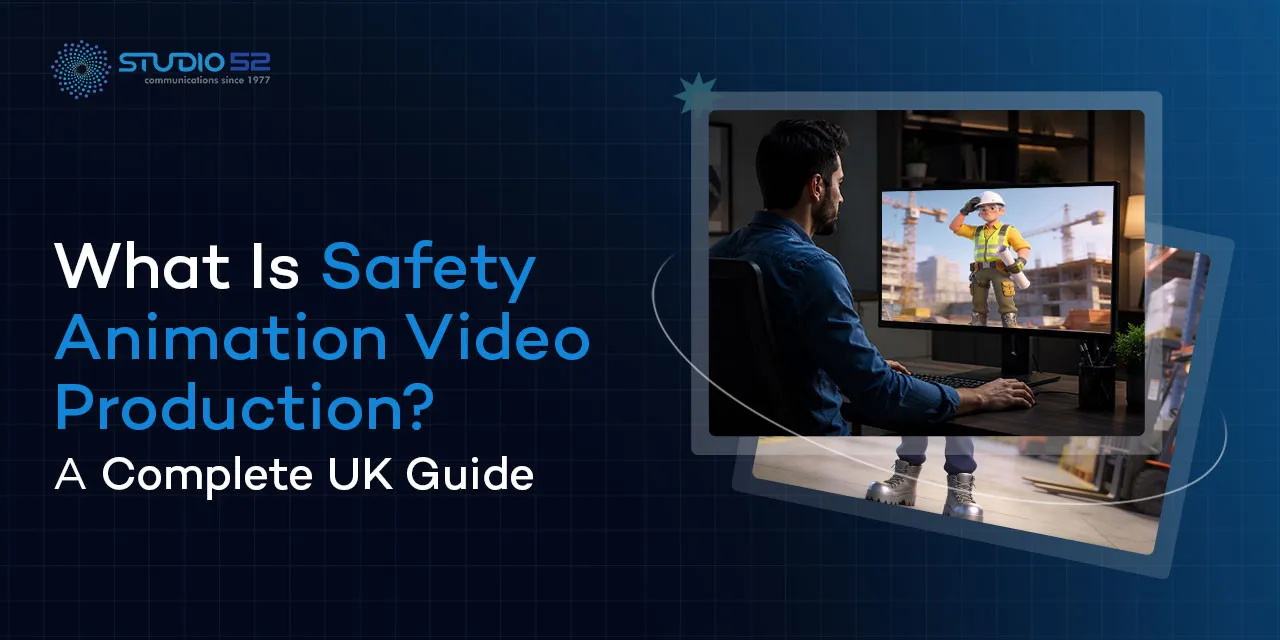
Safety animation video production is the creation of animated videos that present workplace risks and processes without filming real people and places. Scenes, hazards and equipment are built or drawn rather than filmed — which means you can show situations that would be unsafe, impractical or impossible to film. Common styles include:
- 2D animation
- 3D animation
- Motion graphics
The style is chosen according to the level of technical detail needed and the instructional purpose.
How safety animation videos are created
Understanding the safety requirements
Production begins by defining the hazards involved, the target audience and the training goals. A general induction video looks very different to one built around technical isolation procedures.
Scriptwriting and storyboarding
Technical and regulatory information is distilled into a coherent visual narrative. This is arguably the most critical step: a well-structured script determines whether the finished video actually lands its safety message.
Character and environment design
Workers and their workplace are designed — as simplified 2D characters or in full 3D. 3D projects benefit enormously from accurate technical references supplied by the client at this stage.
Animation and voiceover production
Movement, narration and sound effects bring the storyboard to life. Pacing and clarity are tested here: a rushed scene or poorly delivered narration can undo solid scripting.
Technical and safety review
The procedures shown should be validated by safety managers and subject-matter experts before delivery. An animation that looks real but shows the wrong steps is worse than no video at all.
Final delivery
Videos are formatted for wherever they'll be used — an LMS, the company intranet or website, or a live presentation — usually in more than one format and resolution.
Types of safety animation videos
- Workplace induction videos
- General health and safety training
- Hazard awareness videos
- Equipment operation animation
- Emergency response and evacuation
- PPE training
- Toolbox talks and safety moments
- Incident recreation
- Lessons-learnt and procedure videos
Why UK businesses use animated safety videos
Animation makes technical safety information easier to digest and can show genuinely hazardous situations without putting anyone at risk. It keeps the message consistent across sites — every location hears exactly the same approved content — and improves attention and retention compared with static material. It also supports multilingual workforces without starting from scratch, makes invisible dangers and internal processes visible, and can reduce the cost of repeated instructor-led sessions.
2D animation vs live-action safety videos
- Production process — live action needs locations, actors and crews; animation is built from scripts and digital assets.
- Cost and timeline — live action incurs re-filming costs when things change; animation has a higher upfront effort but lower long-term update costs.
- Realism and flexibility — live action offers natural human realism; animation can reveal hidden hazards and be modified later without reshoots.
For hazardous environments, animation usually wins, because nobody has to be physically present in a dangerous place to make the footage. Many UK productions blend the two.
Industries that need safety animation videos
- Construction
- Oil and gas
- Manufacturing
- Warehousing and logistics
- Energy and utilities
- Environmental services
- Chemical industries
- Pharmaceuticals
UK workplace safety and compliance training
Animated safety videos are an excellent way to communicate a company's safe working practices clearly and consistently, supporting the risk assessments and procedures that sit behind formal training, and helping maintain consistent training records. Whatever the format, safety content should always be vetted by a knowledgeable person before it's used.
What an effective safety animation must have
- Clear learning objectives defined before design starts
- Authentic workplace environments
- Technical accuracy where it matters
- Simple language and focused messaging
- Professionally produced voiceover and subtitles
- Company branding applied appropriately
- Multilingual versions where needed
- Knowledge checks where relevant
- Mobile and LMS formats, so the video actually gets seen
UK production cost of a safety animation video
Cost depends on the length of the video, whether it's 2D or 3D, its visual complexity, the number of languages and the deadline. As a rule of thumb, the lowest cost is short 2D content in a single language; the highest is detailed 3D content in multiple languages on a tight deadline.
How long does it take to produce a safety animation?
Production follows the stages above, and client review and approval of the script and storyboard usually determine how long the project takes. Businesses planning urgent safety campaigns should build in review time — good animation can't be produced in days.
How to pick a safety animation company in the UK
Look for specific industry experience rather than general animation credentials, and a real appreciation of safety communication. Check portfolios in similar industries, ask about the technical accuracy and review process, confirm language capability if needed, and agree pricing, timelines and revision policies up front — including support for future updates, because procedures rarely stay static for long.
Common mistakes to avoid
- Overloading one video instead of breaking it into targeted modules
- Workplace scenes that don't reflect reality
- Prioritising visual polish over learning outcomes
- Excessive technical jargon
- Skipping expert review before going live
- No captions or accessible formats
- Treating the video as a substitute for practical training rather than one part of a broader programme
Conclusion
Safety animation gives UK businesses a realistic way to make complex safety information simple, without putting anyone at risk during production. With workforces increasingly distributed and multilingual, clear and accurate safety communication matters more than ever — and the return on investment comes down to choosing an industrially experienced production partner, not just an animation studio.
Frequently asked questions
How long should a workplace safety video be?
As short as the content allows while clearly covering its intent — focused, smaller modules usually work better than one long video.
Can animated videos illustrate machinery and dangerous processes?
Yes, especially 3D animation, where equipment and dangerous situations can be modelled accurately and safely.
When should safety training videos be updated?
Whenever procedures, equipment or PPE change, and as regulations require.
Can a safety animation be added to an LMS?
Yes — most animated safety videos are delivered in formats suited to standard learning management systems.
Talk to Studio 52
Make your message clearer, more engaging and more memorable.