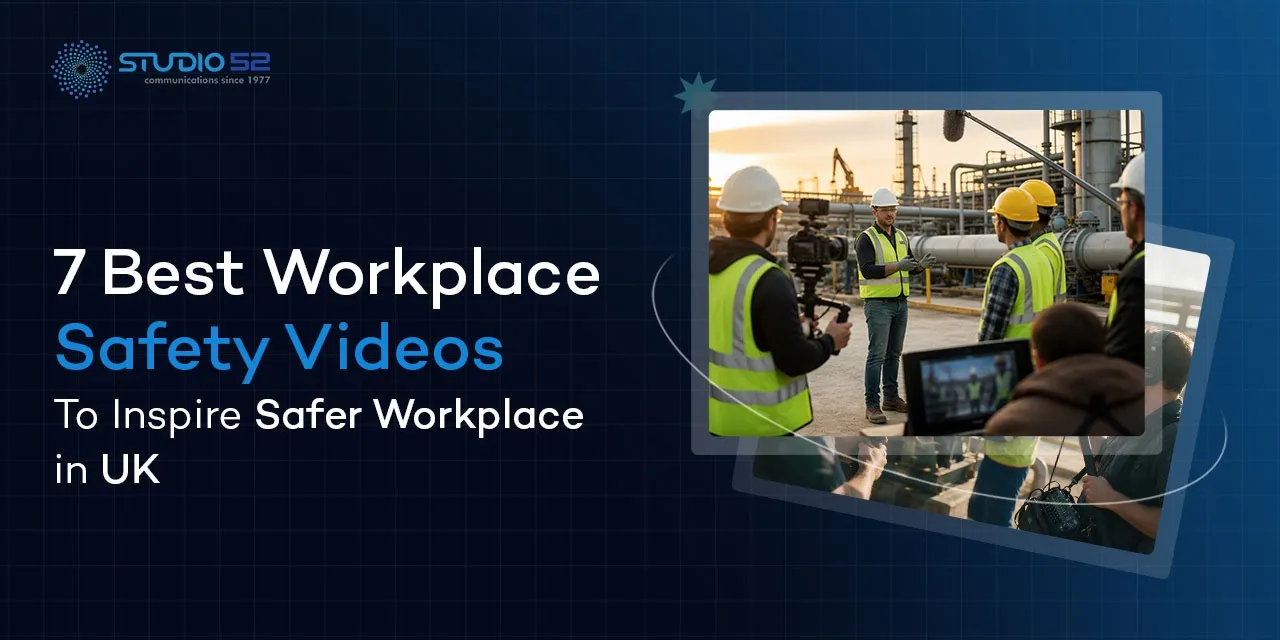
Seven workplace safety video formats — from lifting operations to emergency response — that help UK businesses communicate hazards and build a stronger safety culture.
Workplace safety remains a critical priority for businesses across the UK. Despite decades of health and safety regulation and improved working practices, workplace injuries, occupational illnesses and fatalities continue to affect employees and businesses.
According to the Health and Safety Executive (HSE), 124 workers were killed in work-related accidents in Great Britain during 2024/25, while an estimated 1.9 million workers suffered work-related ill health. HSE also reported around 680,000 self-reported non-fatal workplace injuries during the same period. These figures show why effective health and safety training is essential across UK workplaces.
Presentations, lengthy manuals and written instructions can be difficult to retain — particularly when employees need to understand complex procedures or recognise hazards in real-world situations. Workplace safety videos provide a far more engaging way to demonstrate risks, explain procedures and reinforce safe working behaviours.
From construction and manufacturing to oil and gas, logistics and engineering, professionally produced safety training videos help organisations communicate important safety information consistently across their workforce. Here are seven workplace safety video examples to inspire businesses looking to strengthen their safety training.
1. Lifting operations safety video
Lifting operations carry significant risk when workers, lifting equipment and heavy loads operate in the same environment. A well-designed lifting operations safety video demonstrates correct procedures and highlights the potential consequences of unsafe practices.
Studio 52 creates workplace safety videos that explain essential precautions around lifting activities, including risk assessment, equipment checks, safe working procedures, exclusion zones and communication between operators and ground personnel. For UK businesses, these videos can be tailored to the organisation's own site procedures, equipment and workforce.
This type of safety training video is particularly useful for:
- Construction companies
- Engineering businesses
- Warehousing and logistics operations
- Manufacturing facilities
- Energy and utilities companies
- Maintenance teams
By combining live-action footage and animation in a hybrid approach, businesses can make complex lifting procedures easier for employees to understand and remember.
2. Life-saving rules for driving and vehicle safety
Driving is an essential part of many UK industries, but vehicle-related activities create serious risks for drivers, passengers, pedestrians and other road users. A driver safety video communicates important behaviours before employees get behind the wheel or operate workplace vehicles. It can cover:
- Seat belt use
- Vehicle inspections
- Speed management
- Safe following distances
- Mobile phone restrictions
- Driver fatigue
- Pedestrian awareness
- Reversing and manoeuvring
- Safe vehicle loading
Rather than simply listing rules, the video can show what happens when these precautions are ignored. For companies with delivery fleets, commercial vehicles, forklifts, plant machinery or site transport, vehicle safety videos become an important part of induction and refresher training. Short safety-moment videos can also be used in toolbox talks and team briefings to keep vehicle safety visible all year.
3. Safety and training video for warehousing and industrial operations
Warehouses and industrial facilities combine people, machinery, vehicles, materials and time-sensitive operations. Without appropriate controls, these environments present multiple hazards. A workplace safety video can demonstrate safe working practices in a realistic, easy-to-understand format — for example:
- Forklift and pedestrian segregation
- Safe material handling
- Loading and unloading procedures
- Workplace traffic routes
- Blind spots
- Manual handling
- Storage and stacking
- Personal protective equipment
- Emergency procedures
For UK warehouse operators, safety videos can be customised around the company's actual facility, equipment and operating procedures — making training more relevant than generic material and helping employees recognise hazards where they actually work.
4. Occupational safety video for high-risk workplaces
High-risk industries require employees to understand both the hazards they may encounter and the actions expected of them. An occupational safety video can take employees through a typical working day, showing how safety procedures fit into everyday activities:
- Reporting to the relevant supervisor
- Completing required safety checks
- Understanding the day's work activities
- Identifying potential hazards
- Following authorised instructions
- Using appropriate PPE
- Reporting unsafe conditions
- Responding correctly to emergencies
Animated safety videos are especially effective for procedures that are difficult to film, or when businesses want to visualise hazardous scenarios without placing anyone in danger.
5. Lessons-learnt video: the consequences of distraction
One of the most effective approaches to safety communication is showing what can happen when a seemingly small mistake has serious consequences. A lessons-learnt video recreates a realistic incident — for example, a driver distracted by a mobile phone — and shows how a chain of decisions leads to an accident.
The objective isn't simply to show the accident. The video should help employees understand what went wrong, why it happened, which warning signs were missed, what could have prevented it, and what they should do differently. Lessons-learnt videos can also be adapted to reflect an organisation's own previous incidents and near misses.
6. Safe system of work training video
A Safe System of Work (SSoW) gives employees a structured approach to carrying out tasks safely, but written procedures alone don't always show how they apply in practice. A training video turns a complex SSoW into a clear visual sequence: planning the task, reviewing the risk assessment, identifying hazards, confirming controls, checking equipment, using PPE, following authorised procedures, communicating with colleagues, reporting unsafe conditions and handing over to the next team.
It's particularly useful when the same procedure must be communicated consistently across teams, locations or shifts.
7. Safety awareness and emergency response video
A strong safety culture depends on employees knowing what to do when something goes wrong. An emergency response video can show how to recognise unsafe conditions, report hazards promptly, respond to alarms, follow evacuation procedures, move to assembly points, communicate with supervisors and avoid unnecessary risks.
Animation is particularly useful for emergency scenarios that would be difficult, expensive or unsafe to recreate through live filming.
Why should UK businesses use workplace safety videos?
- Improved hazard awareness — employees see potential risks and how to control them.
- Consistent training — the same message reaches every location and shift.
- Better retention — visual storytelling makes safety messages easier to remember.
- More engaging inductions — onboarding becomes more interactive.
- Support for toolbox talks — short videos reinforce specific risks regularly.
- Reduced training disruption — video complements classroom and practical training.
- Support for audits and compliance — documented resources demonstrate commitment to health and safety.
- Safer communication of high-risk scenarios — dangerous situations can be recreated through animation.
Workplace safety video solutions for UK businesses
| Safety video type | What it covers | Ideal for |
|---|---|---|
| Workplace safety training | Hazards, procedures and safe working practices | All industries |
| Employee safety induction | Rules, hazards, responsibilities, emergency procedures | All workplaces |
| Fire safety training | Prevention, evacuation and emergency response | Commercial and industrial buildings |
| PPE training | Selection, correct use, inspection and maintenance | Construction, manufacturing, energy |
| Construction safety | Site safety, working at height, plant and equipment | Construction companies |
| Oil & gas safety | Permit to work, confined spaces, operational hazards | Energy and oil & gas |
| Warehouse safety | Forklifts, pedestrian safety, storage, handling | Warehousing and logistics |
| Animated safety videos | 2D and 3D animation of complex procedures | All industries |
| Custom workplace safety videos | Bespoke content for your site, workforce and procedures | All industries |
Why choose professional safety video production?
An effective safety video involves more than recording a presentation. The content must be accurate, engaging and relevant to the people who will use it. At Studio 52 we create customised workplace safety videos for businesses in high-risk and complex environments, including live-action safety filming, 2D and 3D animated safety videos, CGI visualisation, hybrid productions, safety inductions, toolbox talk and safety-moment videos, lessons-learnt videos and emergency response videos.
Conclusion
Workplace safety is an ongoing responsibility for every UK organisation. The right safety videos turn complicated procedures into easy-to-understand visual experiences, recreate potential incidents, reinforce procedures and help build a stronger safety culture.
Studio 52 creates professional workplace safety videos and animated safety videos designed for complex and high-risk industries. If you want to make your safety communication clearer and more memorable, speak to our safety video production team today.
Frequently asked questions
What is a workplace safety video?
A visual training resource that educates employees about workplace hazards, safe working procedures, emergency responses and expected safety behaviours — used in inductions, refresher training, toolbox talks and wider safety programmes.
Should I choose an animated or live-action safety video?
Both work. Animation is ideal for complex systems and hazardous scenarios that are difficult to film; live action is useful when employees need to see their actual workplace and equipment. A hybrid approach combines the strengths of both.
Can safety videos be customised for our workplace?
Yes. Custom safety videos can be built around your actual workplace, machinery, processes, hazards, workforce, branding and procedures.
Are safety videos useful for high-risk industries?
Yes — they're most valuable there, because they demonstrate hazards and procedures without exposing employees to danger during training.
Talk to Studio 52
Make your message clearer, more engaging and more memorable.