Why industrial safety training is hard to communicate, how 3D animation solves it, and what UK businesses should look for in an animation partner.
Introduction
Safety training is only as effective as its ability to be understood, remembered and applied. Across UK industrial workplaces — from factory floors to construction sites — employees are expected to absorb detailed procedures, recognise hazards and respond correctly under pressure. Manuals, slideshows and classroom sessions often struggle to convey this in a way that genuinely sticks.
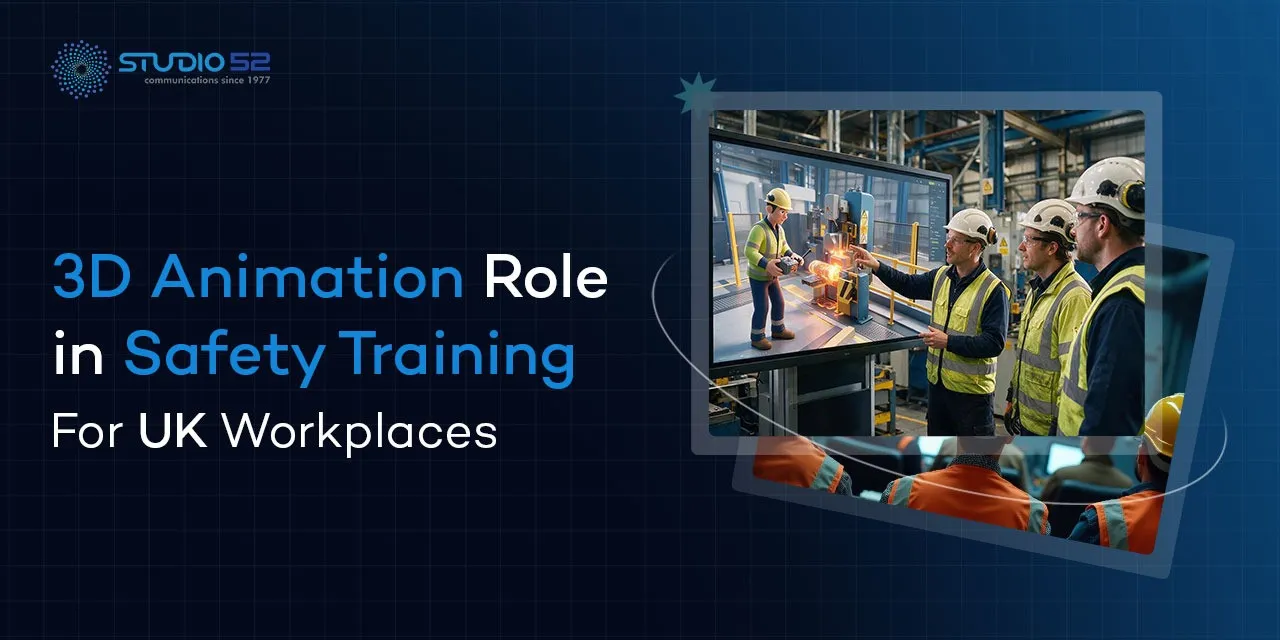
This is where 3D animation video production makes a measurable difference. Rather than describing a hazard in text or showing a static diagram, animation lets safety teams visualise exactly how a process works, where risks arise and what correct behaviour looks like — particularly around heavy machinery, confined spaces and hazardous materials.
Why safety training can be difficult to communicate
Industrial safety training involves technical processes, regulatory terminology and multi-step procedures that are hard to explain through text or verbal instruction alone. Employees may read a procedure without fully understanding the sequence of actions, or the exact point at which risk increases.
Some hazards are also genuinely hard to demonstrate safely. Showing what happens when a machine guard fails, or how gas builds up in a confined space, can't be recreated on camera without real danger. Many organisations fall back on generic imagery or written warnings — leaving gaps in understanding that only become apparent after an incident.
How 3D animation supports industrial safety training
Makes complex processes easier to understand
Animation breaks processes down step by step, showing how equipment operates, where a worker should stand and how tasks should be carried out — so even highly technical procedures can be grasped at a glance.
Demonstrates hazards without real-world risk
Equipment failure, chemical exposure or a confined space collapse can be shown clearly and safely: what goes wrong, why it happens and how it could have been prevented, with no one placed at risk during production.
Helps employees visualise different scenarios
Animation can be adapted to show different machine types or site configurations, helping employees recognise hazards in situations that closely match their own working environment.
Where 3D safety animation can be used
Manufacturing and engineering — machine operation, guarding requirements and safe handling of moving parts.
Construction and infrastructure — from working at height to excavation safety, teams can visualise site-specific hazards before work begins.
Logistics and warehousing — safe forklift operation, racking safety and pedestrian–vehicle separation.
Oil and gas — pressure systems and hazardous materials demonstrated clearly without real-world exposure.
3D animation vs traditional safety training
Printed manuals, static diagrams and lectures rely heavily on employees' imagination to translate instructions into real-world understanding, which leads to inconsistent interpretation. 3D animation removes much of the guesswork by visually demonstrating exactly what should happen, step by step. Traditional methods still deliver policy and procedure; animation adds a layer of clarity they often can't.
Creating effective safety animation for UK workplaces
Effective safety animation reflects real workplace conditions, UK regulatory requirements and the specific hazards of a site or sector. Generic off-the-shelf content rarely connects the way animation built around employees' actual equipment and layout does. Close collaboration between the production team and the organisation's HSE professionals keeps the content technically accurate and engaging.
Why businesses are turning to animation for safety communication
Animation solves problems filming can't: dangerous scenarios shown without risk, complex processes broken down clearly, and content that's easy to update as procedures or equipment change. It also holds attention better than static materials, supporting better retention of key safety messages.
Choosing the right animation production partner
Look for a provider with genuine experience in industrial and safety content — not just marketing animation — and the technical understanding to represent equipment, hazards and procedures correctly.
Studio 52 brings decades of audiovisual production experience to safety animation, combining technical accuracy with strong visual storytelling. We work closely with UK businesses to understand site-specific hazards and translate them into clear, professional 3D animation that supports genuine safety outcomes — rather than simply ticking a training box.
Bringing safety training to life with 3D animation
Safety training succeeds when employees genuinely understand the risks they face and know how to respond. 3D animation brings procedures, hazards and consequences to life in a format that is safe to produce, easy to update and far more memorable than traditional materials.
Ready to strengthen your safety training? Talk to Studio 52 today.
Frequently asked questions
How can 3D animation improve safety training?
By visually demonstrating procedures and hazards step by step, making complex processes easier to understand and helping employees retain key safety messages far better than text-based training alone.
Can 3D animation demonstrate dangerous workplace scenarios?
Yes. Equipment failure, chemical exposure or confined space hazards can be illustrated without recreating dangerous conditions during filming.
What is the difference between 2D and 3D animation for safety training?
3D animation offers greater depth and realism, showing equipment and spaces from multiple angles; 2D is often used for simpler, more schematic explanations.
Can Studio 52 produce 3D safety animation for UK businesses?
Yes. Studio 52 has extensive experience producing safety and industrial animation for UK businesses, combining technical understanding with professional visual storytelling.
Talk to Studio 52
Make your message clearer, more engaging and more memorable.